
Glue Down vs Click LVT vs SPC Rigid Core (UK Guide)
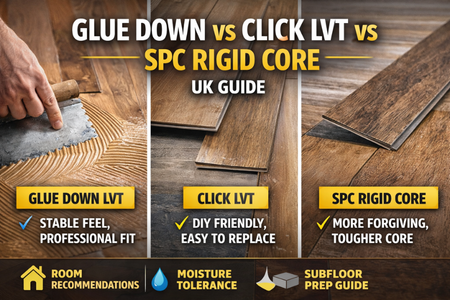
If you’ve been shopping for vinyl flooring in the UK, you’ve probably had this exact moment:
You type in “vinyl flooring,” and suddenly you’re drowning in options.
Glue down LVT. Click LVT. SPC rigid core. Luxury vinyl. Rigid core vinyl.
And every product description basically says the same thing:
- “Waterproof”
- “Hard-wearing”
- “Easy to install”
- “Perfect for any room”
Which is… not helpful.
Because these floors are not the same.
In fact, choosing the wrong type is one of the fastest ways to end up with problems like:
- A floor that feels bouncy or “hollow”
- Joints that start separating
- Tiles lifting at the edges
- Water sneaking into the wrong places
- A finish that looks scratched far earlier than expected
So in this guide, I’m going to make it simple.
We’ll break down the three main options in plain English, and I’ll show you exactly which one makes sense depending on your home, your subfloor, and the room you’re fitting.
We’ll cover:
- Glue down vs click LVT vs SPC rigid core: what they actually are
- The real pros and cons (not marketing fluff)
- Room-by-room recommendations (bathroom, kitchen, hallway, home office)
- Underlay and subfloor prep, without the jargon
- A copy-and-paste buying checklist so you can pick with confidence
If you want to browse as you read, keep these open:
Alright. Let’s cut through the noise and get you the right vinyl the first time.
Glue Down vs Click LVT vs SPC Rigid Core (What Each One Actually Is)
Before we get into the “which should I buy?” part, we need to get the language clear.
Because most people aren’t confused by flooring.
They’re confused by flooring words.
Here are the three options in plain English.
Glue Down LVT
Glue-down LVT is vinyl in plank or tile form that gets bonded directly to the subfloor with adhesive.
Think: stable, professional, “once it’s down, it’s down”.
It’s the option installers love for a reason, but it demands prep.
If your subfloor is not flat and smooth, glue down will expose it.
Browse LVT options here: LVT Flooring
Click LVT
Click LVT looks similar, but instead of being glued, it uses a click-lock system and “floats” over the subfloor.
Translation: faster to fit, great for DIY, and easier to replace later.
But it can feel slightly more “floating” underfoot if the subfloor or underlay isn’t right.
SPC Rigid Core
SPC rigid core is a type of vinyl flooring built around a stiffer core (the “rigid core” part).
It’s designed to be more stable and more tolerant of minor subfloor imperfections than standard click vinyl.
In simple terms, it’s often the best “low stress” option when you want a tough vinyl floor, but your subfloor isn’t perfectly smooth.
You’ll sometimes see it described as rigid core vinyl flooring or SPC flooring.
If you’re browsing vinyl beyond LVT, start here: Vinyl Flooring
The Quick Answer (Choose This If You Have This)
If you want the short version before we go deep, this section is for you.
Because most buyers don’t need a “full flooring dissertation”.
They need a confident decision.
Here’s a quick decision guide you can screenshot.
Comparison Table
| If you have… | Best choice | Why it works | Watch out for |
| Slightly uneven subfloor | SPC rigid core | More tolerant, stable, less likely to telegraph bumps | Can feel firmer underfoot |
| You want the most solid, “stuck down” feel | Glue down LVT | Feels premium, no bounce, seamless repairs possible | Prep is non-negotiable |
| You want DIY speed and simpler fitting | Click LVT | Easier install, easy to replace sections | Needs a decent subfloor, or it can feel hollow |
| Rental property or high turnover | SPC rigid core or Glue-down LVT | Durable and stable, with fewer callbacks | Avoid poor prep, especially around edges |
| Underfloor heating | Glue down LVT (often best) | Better heat transfer with less “air gap” | Must follow product install guidance |
| Bathroom use | Depends on layout (see notes) | Vinyl is water-friendly, but edges matter | Joints and sealing are everything |
| Heavy furniture | Glue down LVT or SPC | Less movement, less risk of joint stress | Protect legs, use pads |
| Busy home: kids, dogs, grit | SPC or Glue down LVT | Tough, stable, handles real life | Pick a finish that hides micro-scratches |
Browse options while you decide:
“Just Tell Me What To Buy” Decision Blocks
If your floor isn’t perfectly smooth
Choose SPC rigid core. It’s the most forgiving option.
If you want the most premium feel and longest-term stability
Choose glue-down LVT, as long as you can get the subfloor properly prepped.
If you’re DIY-ing and want something straightforward
Choose click LVT. It’s usually the easiest route for a clean install.
If you’re fitting a rental and want fewer problems later
Choose SPC rigid core (or glue down if you’re going all-in on prep).
If you’re fitting over underfloor heating
Glue-down LVT is often the most efficient for heat transfer, but always follow manufacturer specs.
The 5 Buyer Questions This Section Answers
1) Which is easiest to install?
Click LVT is usually the easiest.
2) Which feels the most solid underfoot?
Glue down LVT.
3) Which is best for uneven floors?
SPC rigid core.
4) Which lasts longest in busy homes?
SPC and glue down both do well, but only if install is correct.
5) Which is best for bathrooms and kitchens?
All can work, but “waterproof” depends more on edges, joints, and installation than the label.
If you want to reduce risk before you buy, do this one thing:
Order samples first, so you can check texture and finish in your own lighting: Free Samples
Glue Down LVT: Where It Wins (And Where It’s a Pain)
Glue-down LVT is the “installer’s option”.
Not because it’s trendy.
Because when it’s done properly, it feels serious.
No bounce. No hollow sound. No floating movement.
It just feels like part of the building.
But here’s the trade-off:
Glue-down LVT is only as good as the subfloor underneath it.
If the prep is poor, glue down does not hide it. It exposes it.
Why glue down LVT is worth it (the real benefits)
1) It feels the most solid underfoot
If you hate that slight “floating” feeling some click floors can have, glue down is your answer.
2) Great for high traffic and commercial-style wear
Hallways. Open plan. Retail-like footfall at home. Rentals. Busy families.
Glue down handles it well because there’s minimal movement.
3) Thinner profile (often easier at doorways and transitions)
In lots of homes, that matters more than people realise. Less fuss with thresholds and doors.
4) Repairs can be seamless
If a plank gets damaged, a good fitter can replace it without touching the whole floor.
That is a massive win for landlords and anyone who wants a “fixable” floor.
5) Often better for underfloor heating (when installed correctly)
Because there’s less air gap than a floating floor, heat transfer can be more efficient.
Browse LVT options here: LVT Flooring
Where glue-down LVT becomes a problem
Here’s what people don’t tell you in the sales copy:
The subfloor prep is non-negotiable
Glue-down LVT needs a subfloor that is:
- Flat
- Smooth
- Dry
- Clean
- Stable
If your subfloor has dips, bumps, or old adhesive lumps, glue down will “print through”.
That means you’ll see or feel imperfections through the finished floor.
Moisture issues can ruin the job
On concrete, moisture has to be handled properly.
Otherwise adhesive can fail, and you can get lifting or movement.
It’s less DIY-friendly than click systems
Which brings us to the question everyone asks:
“Can I DIY glue down LVT?”
You can, but only if:
- You’re confident with prep
- You can apply adhesive evenly
- You understand open times and working times
- You can cut and fit accurately around edges
- You’re not trying to “wing it” on an uneven subfloor
If your subfloor is already smooth and level, DIY is more realistic.
If it’s not, most DIY mistakes happen at the prep stage, not the sticking stage.
If you’re looking at adhesives, trims, tools, and fitting extras, start here: Accessories
The glue down buyer summary
- Best for: premium feel, high traffic, rentals, underfloor heating
- Biggest downside: prep needs to be perfect
- DIY? possible, but not forgiving
Click LVT: Best for Speed and DIY (With a Few Gotchas)
Click LVT is the option that exploded in popularity for one simple reason:
It makes fitting vinyl feel… achievable.
No trowels. No messy adhesive. No panic about “did I glue this wrong?”
You measure, cut, click, and move on.
That’s why click LVT is often the go-to for:
- DIY home upgrades
- Quick refresh projects
- Busy households that want minimal disruption
- People who want the option to change it later without ripping the subfloor apart
Browse current ranges here: LVT Flooring
Why click LVT is genuinely a great choice
1) Faster installation
If time matters, click wins. Especially in occupied homes.
2) DIY-friendly
Most competent DIYers can install click LVT with basic tools and patience.
3) Easier to replace later
If you damage a plank or want a new look in a few years, it’s often easier than lifting glued planks.
4) Less dependent on adhesives
No worrying about curing times, adhesive compatibility, or spreading consistency.
The “gotchas” people only learn after fitting it
Click LVT is not “problem-free”. It’s just “different problems”.
1) It can telegraph subfloor issues
Click floors float.
So if the subfloor has:
- bumps
- dips
- old adhesive patches
- uneven floorboards
…you can end up with a floor that feels slightly hollow or uneven.
And that can lead to movement, which leads to joint stress over time.
2) Underlay matters (when applicable)
Not all click LVT needs a separate underlay.
Some ranges have an integrated backing, others specify a particular underlay type.
The point is: you can’t guess.
The wrong underlay can cause:
- too much bounce
- joint separation
- noise
- long-term wear at the click points
Underlay, trims, and fitting accessories live here: Accessories
3) It’s not automatically “better for bathrooms.”
Yes, click vinyl can be water-resistant.
But the weak spot is always the same:
the joints and the edges.
Bathrooms can work, but only if you plan edges properly and stop water from sitting where it shouldn’t.
We’ll cover this properly in the room-by-room section.
Click LVT buyer summary
- Best for: DIY, speed, easy upgrades, most homes
- Watch out for: uneven subfloors, wrong underlay, edge detailing in wet areas
- Feels like: slightly more “floating” than glue down if the subfloor isn’t perfect
SPC Rigid Core: The Truth About “Rigid Core” Marketing
If you’ve seen “rigid core” all over vinyl flooring listings, you’re not imagining it.
It’s one of the most overused phrases in the entire flooring world.
But here’s the thing:
Rigid core isn’t just marketing fluff.
It does change how the floor behaves.
You just need to understand what it changes (and what it doesn’t), so you buy it for the right reasons.
What SPC rigid core actually is (plain English)
SPC stands for Stone Plastic Composite.
In reality, you don’t need to care about the acronym.
What you need to know is this:
SPC has a stiffer core, which makes the plank more stable and less flexible than standard click vinyl.
That extra stiffness is the whole point.
It helps the floor stay stable when real life happens.
What “rigid core” improves (and why buyers love it)
1) More tolerant of minor subfloor imperfections
No floor likes a bad subfloor.
But SPC is generally more forgiving than standard click LVT.
So if your floor is “mostly okay” but not perfectly flat, SPC is often the safer bet.
2) More stable in busy homes
In high-traffic zones, stability matters because movement = joint stress.
Less flex can mean:
- fewer micro-gaps
- less long-term separation risk
- less “bounce” underfoot
3) Better for heavy furniture (in many cases)
Big sofas. Dining tables. Heavy wardrobes.
SPC’s stiffness helps keep the floor from feeling like it’s compressing and shifting around high-load areas.
If you’re exploring rigid core ranges, you’ll often find them under broader vinyl categories, too: Vinyl Flooring
What “rigid core” does NOT magically fix
Let’s cut the fantasy.
Rigid core doesn’t mean:
- “Install over anything”
- “No subfloor prep needed”
- “Guaranteed waterproof forever”
It’s more forgiving, not invincible.
If the subfloor is genuinely uneven, damp, or unstable, you still need proper prep.
The one downside people notice: it can feel harder
SPC can feel a bit firmer underfoot compared to glue-down LVT or softer-backed options.
Some people love that “solid” feel.
Others notice it feels less cushioned, especially in rooms where you stand a lot (kitchens).
If comfort matters, you can often balance that with the right underlay where appropriate (and correct product guidance).
Underlay, trims, and fitting extras live here: Accessories
SPC rigid core buyer summary
- Best for: slightly uneven floors, busy homes, rentals, heavy furniture
- Main benefit: stability and forgiveness
- Main downside: can feel firmer underfoot
- Still requires: sensible subfloor prep and edge detailing
Best Choice by Room
This is where the “what should I buy?” question gets answered properly.
Because the best vinyl flooring isn’t one product.
It’s the right product for the room’s problems.
Bathroom
Bathrooms are the ultimate stress test because they combine moisture + edges + steam.
If you want the lowest risk bathroom option
Choose glue-down LVT.
Why? Less movement, fewer joint issues, and a properly bonded floor give water fewer places to creep.
If you’re considering click LVT or SPC in a bathroom
It can work, but you need to be smart:
- Pay attention to edges and transitions
- Do not let water sit at the perimeter
- Plan sealing where needed
- Keep ventilation decent to reduce lingering moisture
AI-friendly takeaway:
Bathrooms favour stability and edge control more than “waterproof” labels.
Browse: LVT Flooring
Kitchen
Kitchens are about spills, chair movement, and constant cleaning.
If you want a premium, long-term kitchen floor
Glue-down LVT is a strong pick because it feels solid and resists movement.
If you’re DIY-ing a kitchen refresh
SPC rigid core or click LVT can work well, but choose a finish that hides micro-scratches and do not skip subfloor prep.
Key kitchen realities:
- Chairs create swirl wear
- Grit is constant
- Water tends to pool near the sink and dishwasher
- “Too wet” mopping kills floors faster than most people realise
Browse: Vinyl Flooring
Hallway and Open Plan
Hallways and open plan spaces are where floors get destroyed by grit and foot pivoting.
If your subfloor is not perfect
SPC rigid core is usually the safest choice.
If you want the most premium and stable feel throughout
Glue down LVT wins, assuming prep is done properly.
Quick win: put a real entrance mat down. Grit is basically sandpaper.
Home Office
Home offices are sneaky high-wear because of rolling chairs.
If you have a rolling chair
Go SPC rigid core or glue-down LVT, and consider a chair mat if you want the floor to look new for longer.
Also, think about sound. If you’re upstairs or in a flat, underlay and fitting choices matter.
Underlay and Subfloor Prep
This is the part most people ignore.
And it’s the part that decides whether your vinyl feels:
- solid
- quiet
- premium
or - bouncy
- hollow
- annoying
The only three things that matter
1) Flatness
If the subfloor has bumps and dips, your floor will show it sooner or later.
2) Moisture
Concrete especially. Moisture issues cause adhesive problems and can create movement.
3) Transitions and edges
Doorways, thresholds, skirting edges. This is where water sneaks in and where floors start to fail.
Underlay: when it matters
- Glue down LVT: underlay generally isn’t the “thing”, prep and adhesive are
- Click LVT or SPC: underlay may be required, depending on product design, and it affects feel and sound
Underlay, trims, adhesives, tools and fitting extras: Accessories
Cost, Lifespan, and What You’re Really Paying For
People think they’re paying for the flooring.
In reality, you’re paying for:
- stability
- ease of installation
- subfloor forgiveness
- repairability
- how long does it look good
Why cheap installs fail (even with decent products)
Most failures are install-related:
- uneven subfloor causes movement
- wrong adhesive causes lifting
- poor edge detail lets water creep in
- wrong underlay adds bounce and stresses joints
So when you’re comparing prices, think like this:
A slightly better floor and correct prep is often cheaper than “saving money” and refitting in two years.
Buying Checklist
Use this before you order.
- Identify your room’s main risk: water, grit, chair movement, uneven subfloor
- Choose product type: glue down, click, or SPC rigid core
- Confirm subfloor condition: flat, dry, stable
- Decide DIY vs professional fitting (be honest)
- Plan edges and transitions (doorways, skirting, thresholds)
- Check if an underlay is required for your chosen product
- Order samples to check finish and colour in your lighting: Free Samples
- Measure properly so you do not under or over-order: How to Measure Your Room
- Add accessories upfront (trims, adhesive, tools): Accessories
- Browse your shortlist and buy with confidence: LVT Flooring and Vinyl Flooring
Quick Decision Summary
- Want the most solid, premium feel? Choose glue-down LVT (with proper prep).
- Want DIY speed and flexibility? Choose LVT (but your subfloor needs to be decent).
- Subfloor not perfect, and you want a low-stress choice? Choose SPC rigid core.
- Bathrooms and wet zones reward stability and edge planning, not buzzword “waterproof” claims.
- Most flooring problems are installation problems, so plan prep, edges, and accessories before you buy.
If you want to reduce risk to almost zero, do the simple thing most people skip:
Order samples first: Free Samples
And when you’re ready to narrow down options:
Comments are closed here.