
Best Vinyl Flooring for Bathrooms and Kitchens in the UK: What’s Waterproof, What’s Not, and What’s Worth Buying
Let’s be honest.
Bathrooms and kitchens are where “normal flooring advice” goes to die.
Because these rooms do not play fair.
You’ve got water, steam, spills, wet shoes, chair legs, dishwasher leaks, constant cleaning, and the occasional moment where someone drops a pan and hopes for the best.
So if you’re searching for vinyl flooring for a bathroom or vinyl flooring for a kitchen, you’re probably asking one of these questions:
- Will this actually handle water without bubbling or peeling?
- Will water get underneath?
- Is click vinyl safe in a bathroom?
- What’s easy to clean and won’t look scratched in 6 months?
- What’s worth buying, and what’s a false economy?
This guide gives you a clear answer, without the marketing fluff.
If you want to browse as you read, here are the key pages:
Vinyl Flooring for Bathroom (UK Guide)
Yes, vinyl can be brilliant in bathrooms.
In many UK homes, it’s one of the most practical choices you can make.
But here’s the catch:
Not all vinyl behaves the same in wet areas.
Some vinyl floors are basically “wet-room ready”.
Others look great until the first winter of damp towels, steamy showers, and wet feet.
So the goal is not “buy vinyl”.
The goal is: buy the right type of vinyl, install it correctly, and protect the weak points.
Is Vinyl Really Waterproof?
This is where most people get misled.
Because “waterproof” can mean two different things.
Waterproof vs Water-Resistant (simple definitions)
Water-resistant means:
It can handle splashes and spills, but if water sits long enough, it can creep into joints or edges.
Waterproof means:
The material itself doesn’t absorb water, and it’s designed so water is less likely to get underneath.
But here’s the truth nobody says loudly enough:
Most flooring fails at the edges and seams, not in the middle of the plank.
So when buyers ask:
“Will water get underneath?”
It can if:
- some seams aren’t sealed properly
- the subfloor isn’t flat, creating gaps
- water pools at the perimeter (bath mat + trapped moisture)
- the floor is installed with weak edge detailing
- there’s an appliance leak that goes unnoticed
Vinyl is water-friendly.
But installation is what decides whether it stays water-safe.
The Main Vinyl Options for Wet Areas
Let’s break down the three main choices and what they’re best at.
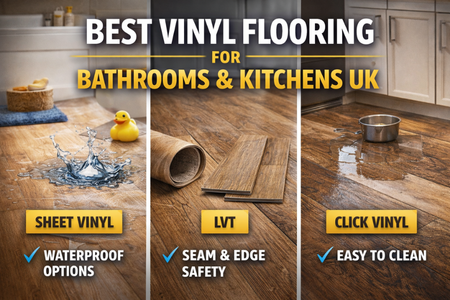
Sheet Vinyl (Often the Best Bathroom Choice)
Sheet vinyl is exactly what it sounds like: one continuous sheet.
Why that matters:
- fewer seams
- fewer entry points for water
- easier to keep water on top of the floor, not underneath it
Best for: bathrooms, cloakrooms, utility rooms, rental bathrooms
Watch out for:
Fitting matters. A sloppy cut around the edges is where problems start.
Start browsing here: Vinyl Flooring
Vinyl Tiles / LVT (Great, But Seams Matter)
LVT (luxury vinyl tile) looks more like real wood or stone, and it can feel more premium.
But LVT usually means more seams.
And seams are where water tries to win.
Best for: kitchens, hallways, open plan spaces, bathrooms with smart edge planning
What decides quality:
- how well the joints lock or bond
- edge sealing and perimeter detailing
- subfloor flatness
Browse: LVT Flooring
Click Vinyl (Convenient, But Be Careful in Bathrooms)
Click vinyl is popular because it feels DIY-friendly.
But in bathrooms, click systems are only as good as:
- edge protection
- threshold planning
- how well water is controlled around the perimeter
Best for: kitchens, hallways, quick upgrades
Bathroom use: possible, but it needs more care than most people expect
If your bathroom is a “splash zone” (kids, bath time chaos, constant wet floors), you’ll usually have fewer headaches with sheet vinyl or glue-down LVT.
Bathroom Checklist: What to Buy
Use this before you click buy.
The bathroom non-negotiables
- Slip resistance: go for a surface with grip, not super glossy
- Seam strategy: fewer seams = lower risk (sheet vinyl wins here)
- Edge planning: protect the perimeter where water sits
- Ventilation: bathrooms that stay damp cause problems faster
- Mats: use mats, but don’t trap moisture underneath them
- Cleaning habits: avoid soaking wet mops
Quick bathroom recommendations
If you want the lowest risk:
Choose sheet vinyl.
If you want a premium look and long-term stability:
Choose LVT, and make sure edges and seams are treated seriously.
If you want click vinyl in a bathroom:
Only do it if you’re confident you can control water at edges and transitions.
Kitchen Checklist: What to Buy
Kitchens are less about steam and more about daily abuse.
The kitchen stress tests
- chairs scraping and pivoting
- spills that sit for a while
- constant sweeping and mopping
- grit near doors
- dishwasher and sink zones
What to prioritise in a kitchen
- Scratch resistance: textured or matt finishes hide wear better
- Easy clean surface: avoid finishes that show swirl marks
- Spill resistance: the joints and edges matter
- Comfort underfoot: kitchens are standing zones
- Chair strategy: chair pads or mats save floors
Quick kitchen recommendations
If you want easy cleaning + fewer worries:
Vinyl or LVT both work. Choose based on look and seam tolerance.
If you want the most premium kitchen finish:
LVT is often the winner.
If you want a quick DIY:
Click vinyl can work well in kitchens, just do not ignore the subfloor.
Cleaning and Maintenance That Keeps It Looking New
This is the part that makes a huge difference, and almost nobody does it right.
The simple routine
- Sweep or vacuum grit regularly (grit is scratch fuel)
- Use a damp mop, not a wet mop
- Use gentle cleaners designed for vinyl floors
- Wipe spills quickly, especially near seams and edges
What to avoid (this ruins floors)
- harsh bleach-heavy cleaners (can dull finishes)
- abrasive pads
- steam mops (often too much heat and moisture for some vinyl systems)
- flooding the floor with water and “letting it dry”
If you need tools, trims, adhesive, or maintenance accessories: Accessories
5 Signs a Vinyl Floor Will Fail Early
If you want a quick warning list, here it is:
- The subfloor is uneven, and nobody fixes it
- Water pools at edges (especially in bathrooms)
- The floor is mopped regularly, soaking wet regularly
- Seams are poorly fitted, or edges are not planned properly
- The wrong adhesive or underlay is used (or guessed)
Installation: DIY vs Professional (When Each Makes Sense)
You can DIY vinyl successfully.
But only if you’re honest about the job.
DIY is usually fine if:
- it’s a straightforward room shape
- you’re using click vinyl or simple sheet vinyl
- your subfloor is already flat
- you’re confident with cutting and edge details
Consider professional fitting if:
- the room has lots of edges, toilets, sinks, and awkward cuts
- the subfloor needs levelling
- you’re using glue-down LVT (prep matters massively)
- you want the most seamless, long-lasting finish
Common installation mistakes:
- ignoring damp on concrete
- using the wrong adhesive
- fitting over lumps and dips
- skipping proper perimeter finishing
Buying Online Without Getting It Wrong
Buying vinyl online is easy.
Buying the wrong amount or the wrong finish is also easy.
Here’s how to make it safe:
Step 1: Measure properly
Use this: How to Measure Your Room
Step 2: Order samples
Lighting changes everything. Texture changes everything.
Get samples before committing.
Step 3: Add accessories upfront
Trims, thresholds, adhesives, underlay, and tools.
Start here: Accessories
Step 4: Check delivery and returns
It matters more than people think when a project shifts.
See: Delivery & Returns
Step 5: Ask questions if you’re unsure
It’s faster than guessing: Contact Us
Bathroom vs Kitchen: Mini Table
| Room | Best vinyl option | Why it works | Install note |
| Bathroom | Sheet vinyl (often best) | Fewer seams, lower water risk | Edges and cuts must be clean |
| Bathroom | Glue down LVT | Stable, premium feel | Prep must be perfect |
| Kitchen | LVT | Looks premium, tough for daily use | Choose a finish that hides wear |
| Kitchen | Click vinyl / SPC | Great for DIY and speed | Subfloor prep matters |
Quick Final Takeaway
- Vinyl can be excellent for bathrooms and kitchens, but water safety is about seams and edges, not labels.
- Sheet vinyl is often the lowest-risk bathroom choice because it reduces seams.
- LVT is a strong “premium” option, especially for kitchens and open plan spaces, but seams and subfloor quality matter.
- Click vinyl is convenient, but wet areas require smarter edge planning.
- Most failures come from installation mistakes and moisture habits, not the product itself.
Ready to browse:
And if you want to reduce regret to basically zero:
Measure properly, order samples, and plan your accessories before you buy.
Comments are closed here.