
Acoustic Wall Panels Explained: Do They Actually Work for Home Offices, Bedrooms and Home Cinemas?
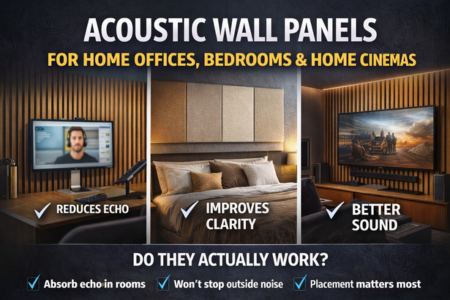
Acoustic wall panels are decorative wall panels designed to absorb sound, which helps reduce echo and improve clarity in a room.
That is the key idea.
Not “soundproofing”. Not “blocking noise from neighbours”. More on that myth in a second.
If you want to browse panels while you read, start here: Acoustic Wall Panels (Wall Panelling)
What acoustic panels actually fix (and what they do not)
Let’s get the biggest confusion out of the way early.
They fix echo and harshness (reverb)
If your room sounds “empty”, “tinny”, or like voices bounce around, that is echo and reverb.
Acoustic wall panels help by absorbing sound energy, which reduces reflections and makes speech, calls, and TV dialogue clearer.
They do not soundproof your room
Soundproofing is about stopping sound from passing through walls, floors, and ceilings.
Acoustic panels are not built for that job.
So if your real problem is “I can hear my neighbour’s TV through the wall”, panels might make your room feel less echoey, but they will not magically block outside noise.
Buyer question: “Will this stop my neighbours hearing me?”
In most normal home situations, no.
It can reduce the “loudness” and sharpness inside your room, but if you need true soundproofing, you usually need construction changes (mass, decoupling, seals).
Myth vs Reality
| Claim | Reality |
| “Acoustic panels are soundproof panels” | They are sound-absorbing, mainly for echo and clarity |
| “One panel will fix the whole room” | Placement matters more than people think |
| “More expensive always means better” | Thickness, backing, and coverage are what count |
| “They work only in studios” | They work great in homes, especially offices and cinemas |
Best places to use panels at home
Acoustic wall panels shine in rooms where you want clarity and comfort, not just “quiet”.
Home office (calls, clarity, echo reduction)
If you do Zoom or Teams calls and your voice sounds “boomy” or “roomy”, panels help a lot.
What improves:
- Your microphone picks up less reflected echo
- Speech sounds clearer
- You feel less fatigue from harsh sounds
Start placement tip: put panels on the wall behind your monitor or on the wall your voice hits first when you speak.
Bedroom (softer sound, calmer feel)
Bedrooms are often full of soft furnishings already (bedding, curtains), so the improvement is subtler.
Where panels help most:
- Minimalist bedrooms with hard walls and floors
- Rooms that feel “sharp” when you talk
- Bedrooms used as a workspace or for content creation
Start placement tip: panels behind the headboard wall can reduce reflections and soften the space.
Living room (TV clarity, less harshness)
If your TV dialogue feels muffled or you keep turning subtitles on, it is often not the speakers.
It is the room.
Hard surfaces reflect sound, and dialogue gets smeared.
Panels can reduce reflections and make the sound feel more “focused”.
Start placement tip: panels on the wall behind the TV or on side walls near the main seating position.
Home cinema (dialogue clarity, reflections)
Home cinema is where panels feel like cheating.
You get:
- clearer dialogue
- less “slap echo”
- less ear fatigue at higher volumes
Acoustic slat wall panels are commonly designed to reduce echo and reverberation, which is exactly what you want for cinema clarity.
Start placement tip: prioritize first reflection points on side walls, then add behind the screen wall.
How to choose the right panel type
This is where most people overthink it.
You do not need to become an acoustics engineer.
You just need to choose the right style for your goal and your room.
1) Acoustic slat wall panels (the popular “feature wall” look)
These are the ones you see everywhere right now: wood slats on an acoustic felt backing.
They combine aesthetics with echo reduction and are designed to reduce reverberation.
Choose slat panels if you want:
- a feature wall that looks premium
- noticeable echo reduction
- a “home office meets interior design” vibe
Browse examples: WondaWall Acoustic Slat Wall Panels
2) Decorative acoustic wall panels
These are about blending in with the room style while still taming reflections.
Choose decorative panels if you want:
- acoustic improvement without a big visual statement
- softer, calmer room tone for bedrooms and living rooms
Start here: Acoustic Wall Panels (Wall Panelling)
3) Thickness and backing material (what actually matters)
Here’s the simple truth:
For absorption, coverage + backing + thickness matter more than “brand hype”.
Many slat panels use acoustic felt backing, and some ranges highlight recycled felt and recyclable materials.
If your room is very echoey, more coverage and a thicker, more absorbent backing tends to help.
If your room is mildly echoey, a single feature wall can still make a noticeable difference.
Placement guide that actually works
Most people install panels where they look nice.
That is fine.
But if you want the biggest acoustic impact, use this “start here” approach.
Quick rules
- Start with the wall that reflects sound at you
- Aim at ear height when seated or standing (depending on the room)
- Cover first reflection points first, then expand coverage if needed
- One feature wall beats random scattered panels for most homes
Home office placement
Start here:
- 1 feature wall behind your monitor or behind your chair
If calls still sound echoey:
- add panels to the wall opposite you (the bounce-back wall)
Bedroom placement
Start here:
- headboard wall (feature wall + softer reflections)
If the room is still sharp:
- add a small section on the wall opposite the bed
Living room placement
Start here:
- behind the TV or on the wall facing the sofa
If dialogue still feels messy:
- add panels on side walls near the seating position (first reflection points)
Home cinema placement
Start here:
- side walls at first reflection points
- then behind the screen wall, if you want to go further
Installation options and common mistakes
The good news: acoustic wall panels are usually very easy to install at home.
The bad news: small layout mistakes can make the finished wall look amateur.
Installation options (typical)
- Adhesive bonding
- Mechanical fixing (screws into battens or directly into the wall, depending on the wall type and panel)
For tools, adhesives, and installation bits: Accessories
Wall prep checklist
- The wall is clean, dry, and dust-free
- Locate studs or solid fixing points if needed
- Plan sockets, switches, radiators, skirting, and corners before you start
Common mistakes to avoid
- Not measuring the wall properly (you end up with awkward slivers at the edge)
- Starting crooked (the whole wall looks off, even if it’s only 3mm)
- Ignoring obstacles (switches and sockets ruin the “feature wall” if unplanned)
- Gaps between panels (looks messy, can reduce the “finished” feel)
- No expansion thinking (rooms move, walls are not perfectly square)
If you want to plan your wall like a pro: How to Measure Your Room
And if you’re unsure what you need for your wall type, ask before you buy: Contact Us
Buying checklist (fast, practical)
Copy this into your notes before you order.
Acoustic wall panels buying checklist
- What is the goal: reduce echo or just add a feature wall?
- Which room: office, bedroom, living room, cinema?
- Choose panel type: slat vs decorative
- Decide coverage: 1 feature wall or multiple areas
- Measure wall width and height, plan cuts and edges: How to Measure Your Room
- Check obstacles: sockets, switches, radiators, skirting
- Add install supplies: adhesive, fixings, tools: Accessories
- Plan finish: corners, trims, end cuts
- Order panels: Acoustic Wall Panels (Wall Panelling) (flooringdirect.co.uk)
- If you’re stuck: Contact Us
FAQs
Do acoustic wall panels really work?
Yes, for echo reduction and clarity, especially in home offices and media rooms. (flooringdirect.co.uk)
Will acoustic panels stop noise through walls?
Usually not. They mainly absorb sound inside the room rather than blocking sound transmission.
How many acoustic panels do I need?
For most homes, start with one feature wall in the highest-impact position. If the room is still echoey, increase coverage.
Are acoustic slat wall panels better than flat panels?
Not automatically. Slat panels combine design with absorption, but performance depends on backing, thickness, and how much wall you cover.
Where should I put panels in a home office?
Start behind your desk or behind your chair, then add the wall opposite if needed.
Can I install acoustic wall panels myself?
Often yes, if you measure carefully, prep the wall, and plan cuts around sockets and corners.
Quick decision summary
- Acoustic wall panels reduce echo and reverb, improving clarity and comfort.
- They are not true soundproofing, so do not expect them to block neighbours.
- Best home use cases: home office, home cinema, living rooms, and minimalist bedrooms.
- Choose the right style (slat or decorative), then win with placement and coverage.
- Measure properly, plan obstacles, and get the right fixings: Accessories and How to Measure Your Room
If you want to start browsing options right now, Acoustic Wall Panels (Wall Panelling).
Comments are closed here.